

From Pitch-side To Screen: Sports Production MA Graduates Work On The FIFA World Cup

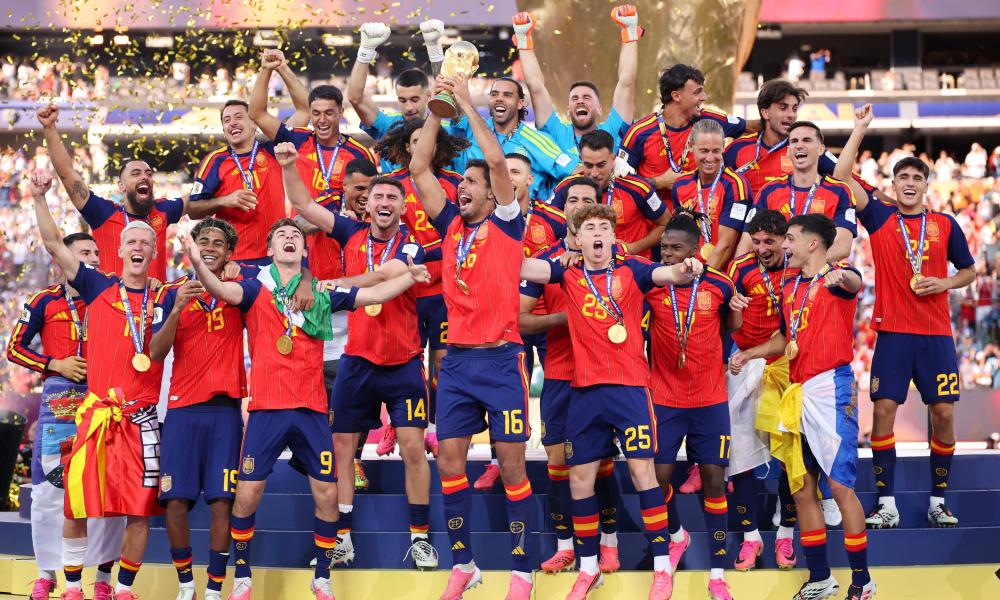
With another unforgettable FIFA World Cup now behind us, fans were treated to a tournament packed with unforgettable moments. While England's wait for World Cup glory continues, Spain emerged victorious, after the final against Argentina.
Behind every moment on the pitch was a dedicated team of broadcast professionals working to bring the action to audiences around the world. Among them were NFTS Sports Production graduates Henry Wodzicki, Ibrahim Ghaznavi, Max Day, Mehul Thakiriya, Sam Rey-Barros and Zak Davis. We caught up with Henry, Ibrahim and Max, who worked as Loggers throughout the tournament, to find out what it was like behind the scenes, how the Sports Production MA prepared them for these roles, and what they love most about working in this industry.
What does a Logger do in the World Cup?
HENRY: We go through training, match, fan and interview footage from pre-match, during the game and post-match, noting what happens as well as highlighting the best bits. This is done on FIFA’s server where broadcasters all over the globe have access to pick clips that they want to show, whether it’s on the news, match coverage, social media etc.
IBRAHIM: We index and tag all incoming media assets from the live match feeds themselves to ISO angles, behind the scenes features and much more! We’re the only production team that see every single second of FIFA World Cup Coverage and lay the groundwork for digital teams and broadcasters to utilise World Cup content.
Could you describe a typical day working on the World Cup?
IBRAHIM: Day to day can vary, depending on the fixtures and your role that day. If you’re working on a fixture, you are designated either the Live world match feed itself, a Clips/ISO angles feed or a Fan Reaction feed. You’re totally immersed in the World Cup coverage, going through hours of footage which most people never see, and deciding what people DO want to see. It was amazing being the first people to make editorial decisions on content and was so rewarding seeing the published content reach millions!
MAX: Long night shifts were the norm, I’d often finish around 7am after working through the night. It was intense, but the team made it fly by. I was working alongside four other NFTS students as well as 13 other loggers so there was always someone to share the highs with. Some of my favourite memories are from those night shifts: the whole team celebrating when Iran scored a dramatic offside winner against Egypt at 5am, and everyone huddled around a screen trying to work out whether the ball really did clip the cable-cam during England vs Norway (no comment…)
What is your favourite thing about making sport content?
IBRAHIM: My favourite thing about making sport content is being able to tell stories that resonate with such wide audiences. Sport touches every corner of the planet and amongst that are incredible stories of success, determination, struggle and resilience. For the World Cup specifically, it was amazing to cover the stories which bring so much joy to people around the world, whether that was Cape Verde’s historic run or Messi’s magic. Producing content in sports makes you understand how important it is in people’s lives.
MAX: Being part of the moments as they happen, live, with a team who are just as invested as you are. Sport is unscripted, you never know what you're going to get and there's something special about experiencing that in real time alongside people who care about it just as much as you do, even in the early hours of the day.
HENRY: I’d say my favourite thing about making sports content is the stories involved in it and showing them to the world. There were some great stories at the World Cup such as South Africa reaching the knockout stages which, after their opening game against Mexico, seemed incredibly unlikely. Being involved in these moments from miles and miles away is still special.
What were you doing before you applied to the NFTS and why did you decide to apply?
IBRAHIM: Before applying to the NFTS, I was working as a pizza chef in a local restaurant! Working in hospitality while juggling freelance work as a runner is something that isn’t unfamiliar in the media industry, and was something which taught me a lot, especially resilience. I was always passionate about football and loved producing content, but wasn’t educated on how to take this into a professional career.
MAX: I had just finished my Undergraduate Degree at the University of Salford and was looking for potential work. The NFTS course came up, and I just felt like this was the perfect fit for me as someone who has a love for sport.
HENRY: Before I joined the NFTS I was working a mixture of hospitality work and freelance editing and was trying to make a break into the film industry, as I had done some film work in the past as a runner. One day I saw an advert for the Sports Production course and thought it looked like a good idea. So I applied thinking “what’s the worst that can happen”. I received an email inviting me for an interview and then later, one with a place on the course. It was definitely the best decision I’ve made for myself.
What are some key skills you learnt at the NFTS that you used in this role?
IBRAHIM: For this role specifically, the NFTS thoroughly improved my editorial skills and thinking from the audience’s point of view. Making these editorial decisions are the foundation of the coverage which the World sees has been an amazing experience and has pushed me to explore this role in more productions.
MAX: I learnt a lot from my time at the NFTS, not just skills with a camera or editing but how to work in a team with likeminded individuals. I realised my love for editing and filming fitted a producer/editor rule which is what the course aims for and being able to do everything myself really helped my creativity and I created pieces I never thought I would.
HENRY: During the course I learnt a lot about what the mindset of a producer is and what footage is useful and what isn’t. This is something that’s particularly helpful when going through hours of footage a day - to think about it from the perspective of an ITV or BBC producer.
What has been your career highlight so far?
IBRAHIM: My career highlight would be the World Cup! I’m lucky enough to have worked on both the 2022 World Cup in Doha and the 2026 World Cup. In 2022 I worked as a runner with the Associated Press, which allowed me to see so much of the tournament, travelling to different stadiums and arenas. On a personal note, it was amazing to be able to work on consecutive World Cups, this time with much more experience and confidence and in a role working directly with Host Broadcast Services on the football content. I am determined to be back for the 2030 world cup!
MAX: Working the World Cup is definitely up there but for me I think the creation of my short documentary, Super Sub for my final project at the NFTS is my favourite. I got to interview Liverpool Legend, David Fairclough. I filmed it alongside my good friend from Salford University up in Liverpool.
HENRY: If someone told me this time last year whilst I was on the course what I’d be doing within a year of leaving it I wouldn’t have believed them to be honest. It’s been a crazy 7 months. One of my highlights has to be being involved in a World Cup, it’s something I dreamed about when I was 6 years and it’s still a surreal experience looking back at it. I now direct live football matches for EFL which is something I never saw coming but absolutely love now.
-
If you’re keen to kick-off your career in sports production and work pitch-side at some of the world’s biggest sporting events, applications are open!
Sports Production MA
1 year, full-time
In person
nfts.co.uk/sports-production