
COURSE OVERVIEW
Take your multi-camera directing and vision mixing career to the next level in live and pre-recorded TV.
There is nothing quite like cutting a live TV show and calling the shots. This unique 12-month MA course aims to prepare you for a successful future as a Multi-Camera Director and Vision Mixer in live and recorded multi-camera studio television production.
The course is run in partnership with Sky, the UK’s largest pay-TV broadcaster, where you'll complete a work placement as part of the course.
Content Tabs
Initially the course will focus on Vision Mixing training elements and once you have learnt the fundamental principles of Vision Mixing and gained some practical skills, the training will widen to include core elements of Multi-Camera Directing.
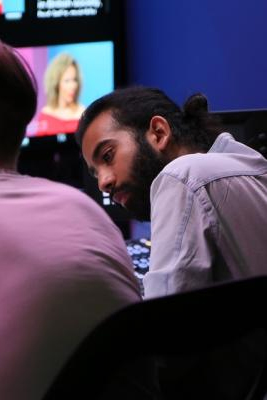
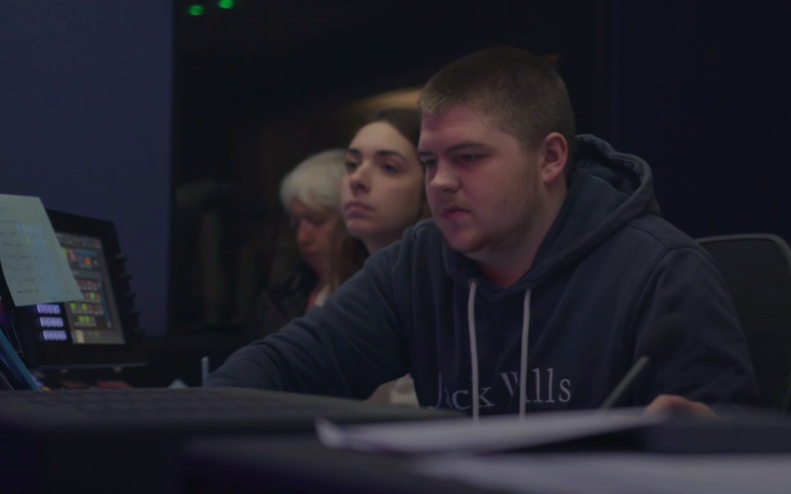
You will closely collaborate with students on other courses to make TV shows in our state-of-the-art 4K TV studio. Our exercise ‘simulator’ also enables you to practise cutting a variety of material on our Sony vision mixer ‘as live’. You will work on multiple genres including sport, music and drama, and you will undertake a six-week placement at Sky where you will train on other industry standard equipment whilst working on current Sky productions.
If you enjoy working as part of a team and find the idea of “live” television exhilarating, then this is the course for you.
Multi Camera Directing and Vision Mixing for TV Production is a specialism within our Cameras, Sound, Multi-Camera Directing and Vision Mixing for TV Production MA.
During the course you will:
- Learn to use a new Sony broadcast vision mixing console, allowing you to create and realise complex live visual effects to the Director’s brief.
- Using high-end production tools, vision mixing is like video editing - but in real time.
- You will practice cutting, mixing and wiping between cameras, pre-edited clips and other video sources live.
- You will learn how to vision mix across a variety of genres from situation comedy to fast paced entertainment and music shows, adding visual effects and captioning in real time.
You will then add Multi Camera Directing skills to your learning as the course develops.
- Understanding the key elements of planning a production from concept to transmission/delivery.
- The core skills of camera operators: positioning, framing and focus.
- Understand the principles of Multi Camera TV production, including the correct use of TV grammar.
- Learn to tell a story in pictures, live and in the moment.
- Working with music to interpret and develop shots, moving with artists or in sympathy with music to create dynamic and exciting television.
- Marking up a camera script, and key Script Supervisor roles.
- Multi-Camera Directing (across various genres including sport, news, chat shows and music).
- The challenge of Multi-Camera Directing whilst Vision Mixing.
A proven interest in multi-camera production and television entertainment plus a willingness to work as part of a team are essential. We are looking for people who are practically minded and who have a good general education although there are no specific educational requirements for this course.
While many applicants will have a degree from a British or overseas university, we will consider applicants who do not have a degree if they have an impressive portfolio, a creative track record or an alternative qualification.
International students Visa and English language requirements
If you have any questions, please email info@nfts.co.uk
The following item(s) should accompany your online application:
- A description of a television production. Please tell us about a television production that you have been involved with or that you have observed. Please detail some of the technical production challenges which were faced in realising the project and in what ways you may have done things differently or enhanced the production. Include information on what preparation the production team would have needed to undertake. If you have not worked on or been involved in a television production, then please describe how you think a television show would be made. This can be a show of your choice and you should include technical aspects such as how many cameras you think are used, what the sound requirements would be, any technical challenges that may be faced etc. (Approx 500 words).
- A video file or URL (web link) to a YouTube or Vimeo clip that you have mixed or edited yourself or which includes vision mixing or editing which you consider to be good. If you are referencing somebody else’s work please explain why you have chosen that piece.
Applications will close at 23:59 on the day of the deadline, shown at the top of this page.
Funding Available
The NFTS offers more scholarships and bursaries to British students, relative to its size, than almost any UK educational institution. If you successfully gain a place on a course, you’ll receive details on how to apply. Funding is available to UK citizens and British passport holders that meet residency requirements ; we recommend international, EU, and EEA students to take a look at our funding guide for helpful advice and resources.
Tutors
Student Showcase
Hear from our students specialising in Cameras, Sound and Multi-Camera Directing and Vision Mixing for Television Production and take a look inside our on-site 4K Television Studio and TV Stage.
Graduate Success
Graduates go on to work as Vision Mixers at Sky Studios, BBC Studioworks, ITV, EMG, Discovery and many others.
Recent credits include...
EastEnders
BBC Studioworks Freelance Vision Mixers Zofia Zblewska, Philippa Neal and Hannah Keegan
Graduate Success
Graduates go on to work as Vision Mixers at Sky Studios, BBC Studioworks, ITV, EMG, Discovery and many others.
Recent credits include...
BBC Proms
Vision Mixer Eleanor Utting
Other credits include: Tokyo Olympics, Strictly: It Takes Two, Michael McIntyre's Big Show
Graduate Success
Graduates go on to work as Vision Mixers at Sky Studios, BBC Studioworks, ITV, EMG, Discovery and many others.
Graduates include...
Bhargav Patel
Vision Mixer at Sky Studios